
Portfolio
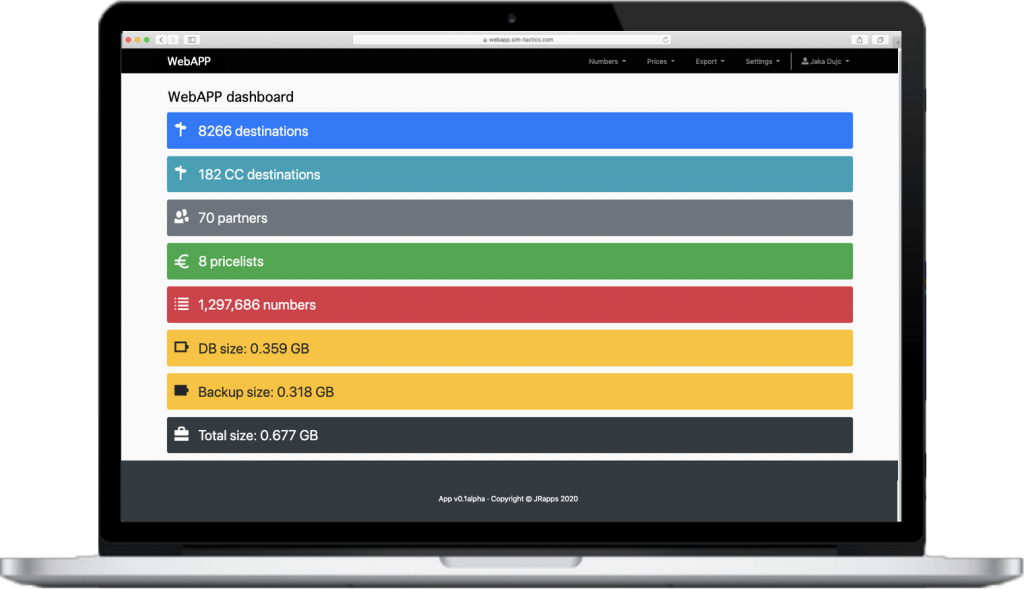
Data Management Web App for Telecommunication Company
- End-to-end cloud-based data management app
- Developed for telecommunication company
- Many managing and export features
- Excel-like experience with responsive HTML
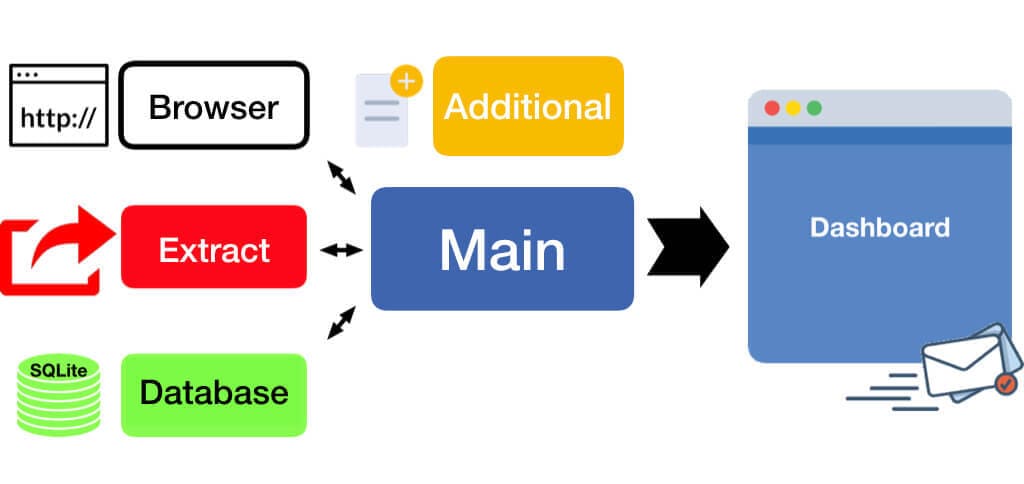
- Frontend and the backend communication via REST API service
An end-to-end cloud-based data management app has been developed for a telecommunication company. To reduce the complexity and streamline the production we made a clear division between the frontend and the backend. The frontend and the backend communicate via the REST API service.
The frontend stack, which considers client’s wishes regarding the excel-like experience with responsive HTML, includes:
- PHP
- Bootstrap
- Jquery
- JExcel
The backend stack includes:
- Python
- Flask
- Sqlalchemy
- SQlite3 database
SQlite3 database can be easily replaced with another solution, should the need occur.
The tool has many managing and export features:
- import of numbers and assignment of numbers to clients
- managing the partner price lists
- managing the partners
- managing the destinations
- partner based exports to Excel (price lists and assigned numbers)
- exporting the file for switch upload
- and many, many more
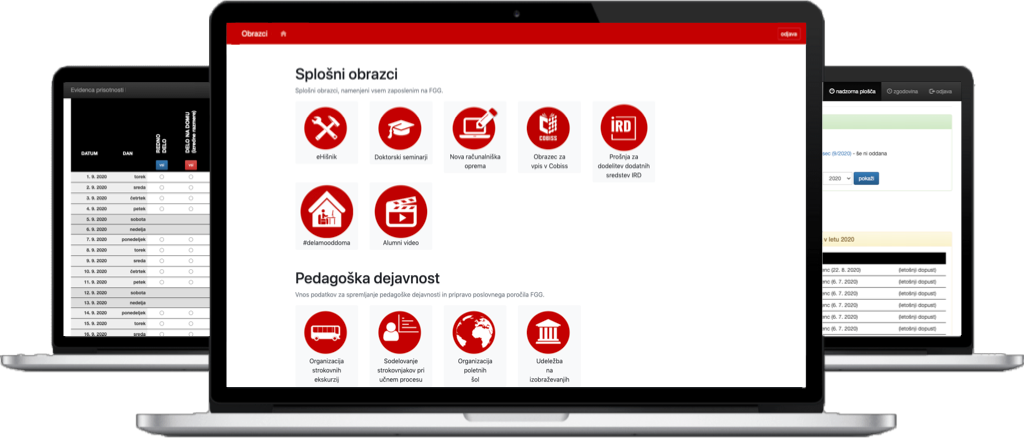
Web forms and human resource management tool
- Cloud-based human resource management tool
- Numerous web forms that help streamline the workflow in a large organisation with more than 400 employees
- PHP, Bootstrap, Vue.js
- SQlite3 database
Web forms and human resource management tools have been developed with:
- PHP
- Bootstrap
- Vue.js
- and SQlite3 database.
This end-to-end cloud based solution includes numerous web forms that help streamline the workflow in a large organisation with more than 400 employees. The employees can utilise the forms to:
- order maintenance work,
- reserve and organise seminars and lectures,
- define the specs for new computers,
- apply for extra research and equipment funding,
- etc…
Another aspect is the cloud based human resource management tool. It allows employees to:
- keep track of their vacation time,
- report their presence (at work, sick-leave, business-trip, etc.),
- and to announce holidays.
The same platform is used by their superiors to manage the requests / reports.

Cryptocurrency trading bot
- A cryptocurrency trading bot
- Managing orders by using WebSocets
- Python, C++, Cython, Jupyter Notebook
- Apache Parquet, Apache Arrow
- Kubernetes cluster with Docker
A cryptocurrency trading bot was developed by using:
- asynchronous Python 3.8,
- C++,
- Cython,
- Apache Parquet,
- Apache Arrow,
- Docker,
- Kubernetes,
- and Jupyter Notebook.
Most of the code is written in asynchronous Python, while certain portions of the code rely on C++ and Cython to increase the performance. The app uses Apache Parquet and Apache Arrow to efficiently store data.
The application was deployed with Docker on Kubernetes cluster.
The Jupyter Notebook was used to prepare the templates for model fitting and for visualisation.
The WebSocket connectors were used for:
- making exchanges,
- supporting collection of order-books,
- for sending orders,
- and for monitoring of orders.
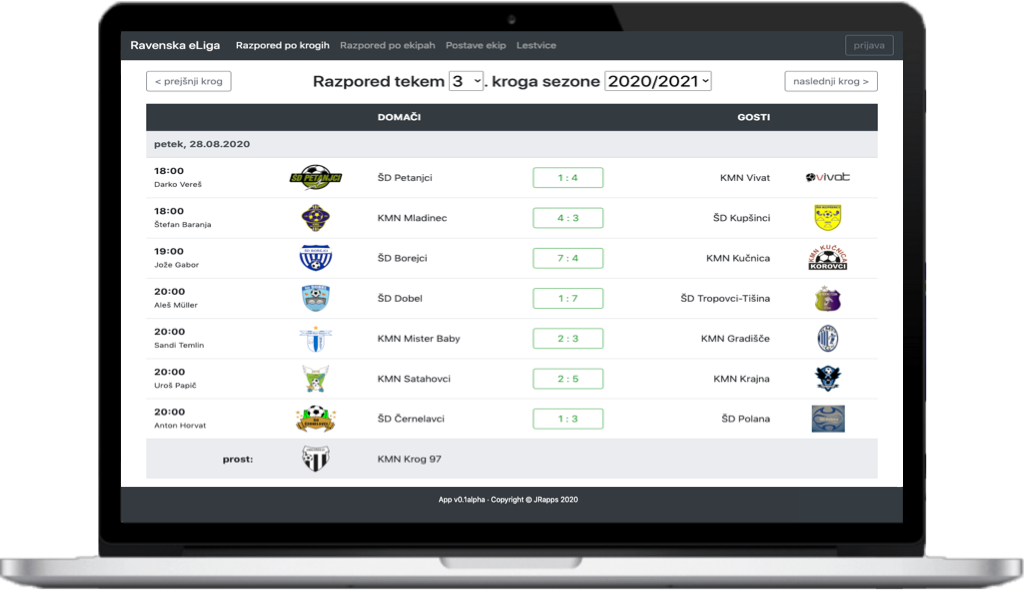
Soccer League Scoreboard
- Cloud based sports league managing tool
- Tracking scores and statistic, presenting rosters, managing league schedule
- PHP, Bootstrap, JQuery
- SQlite3 database
A cloud based sports league managing tool has been developed. This end-to-end solution’s features include:
- tracking scores and statistic,
- presenting teams’ rosters,
- league schedule,
- standings,
- etc…
The app has been developed with:
- PHP,
- Bootstrap,
- JQuery,
- and SQlite3 database.
Live examples are available here:

QR Code based tracking
- End-to-end tracking solution
- Implemented at a higher education facility
- Based on a simple scan of a QR CODE when entering lecture rooms
- PHP, Bootstrap, JavaScript
- SQlite3 database
In the midst of 2020 pandemic arose the need to track the movement of individuals in order to prevent further spread of the disease.
An end-to-end tracking solution that is based on a simple scan of a QR CODE was built with:
- PHP,
- Bootstrap,
- JavaScript,
- and SQlite3 database.
The solution is implemented at a higher education facility where students are requested to use their phones and scan a QR code when entering lecture rooms.
The solution is completely GDPR compliant and no additional software is installed on students’ phones.
Automated monitoring of the availability and pricing of premium event tickets
- Desktop app for automated monitoring of URLs with premium tickets
- Monitoring price changes and ticket availability
- Automatic email notifications
- Python, Selenium, desktop automation
- SQlite3 database
Automated monitoring of the availability and pricing of premium event tickets was custom full stack project made for Ticket Foundary LLC and Renit d.o.o..
The stack for this app included:
- Python as the main language,
- selenium and desktop automation were used for web scraping,
- and SQLite3 database was used for storage.
The basic functionality of the software involved:
- regularly monitoring URLs where premium tickets for events on the primary market are sold,
- checking if new tickets are available,
- checking if prices of old tickets have changed,
- sending email notifications once changes occur,
- and displaying changes and other important information on a simple webpage.
Besides the above, further options were implemented:
- for every event in the database also monitor the prices of tickets on the secondary market,
- compare the prices of the primary and secondary market tickets,
- and determine which tickets are profitable.
Machine Learning: Medical image classification system
- Machine learning
- Medical image classification
- Optimised solution reduces the error by 40%
- Python, Tensorflow, Kubernetes, OpenCV
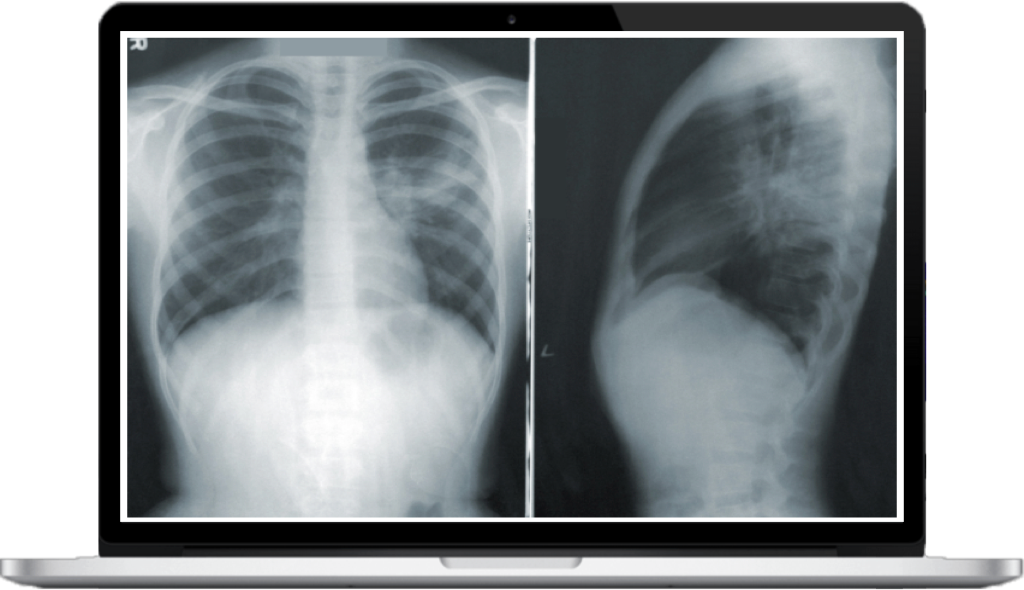
Machine learning automation for medical image classification was developed by using:
- Python,
- Tensorflow,
- Scikit-learn,
- Keras,
- Kubernetes,
- and OpenCV.
The clients’ reference solution was ported from Theano to Tensorflow for production.
Two alternative state-of-the-art models have been implemented and trained by using Keras.
The optimisation of the hyper parameters and the learning procedure reduced the the error rate, as measured by clients’ metrics, by 40%.
The unit tests and deployment artefacts have been produced for the client, including containerised runnable REST API service and Kubernetes configurations.
CRM to Google Sheet syncing
- Cloud based tool for CRM to Google Sheet syncing
- Web scraping techniques to obtain data from CRM
- Building a local database on the syncing server
- Shell script, CasperJS, Google Script, Google Sheet
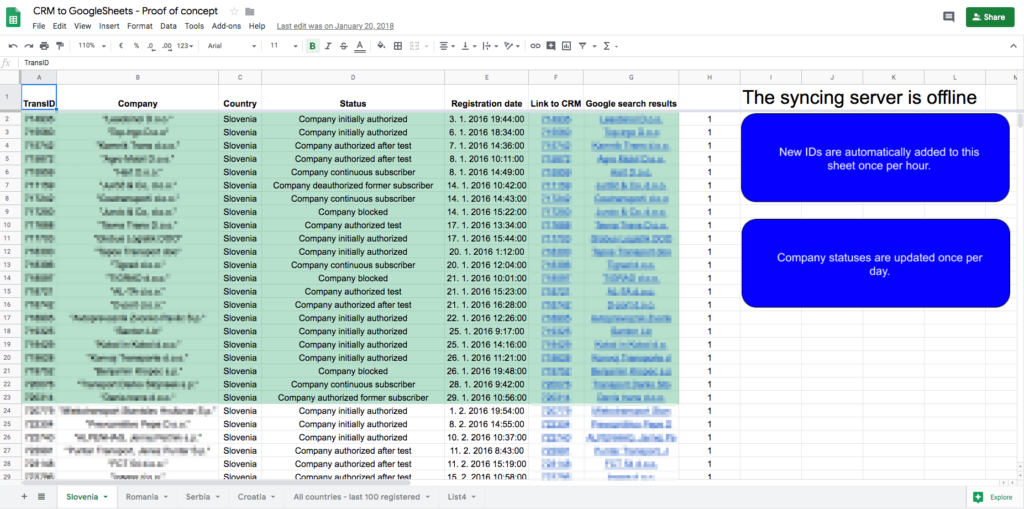
For Trans.EU and it’s Slovenian branch Logintrans d.o.o. a tool for syncing between company’s CRM and Google Sheet environment has been developed.
The stack for this app included:
- shell script,
- CasperJS (Java Script) for web scraping,
- Google script,
- Google Sheet.
The biggest obstacle with this project was the lack of direct access to database behind the CRM. Therefore, web scraping techniques (casperjs) were used to obtain changes/new entries into the CRM.
The scraped data was extracted and stored in a local database on the syncing server.
Google script and time triggers were used to import data from the syncing server into the Google Sheet.

Custom code for numerical simulation of fuel cell stack for automotive industry partner
- custom code for fuel cell stack simulation in automotive applications
- The code was implemented into the Ansys Fluent simulation software
- Automated model generation and reporting
- Ansys Fluent, parallelised C, Pyhton, Ansys Fluent Scripting Language
In collaboration with the ICP (Institute of Computational Physics Zurich University of Applied Sciences – ZHAW) a custom fuel cell stack model has been developed for an automotive company.
Ansys Fluent environment was used as the main tool for CFD simulations.
Additional user defined functions – UDFs and the solution routines were written in approx. 3k lines of parallelised C code. The UDFs describe the electrochemistry and the various fuel cell specific processes:
- the heat production,
- the chemical reactions,
- the through membrane water transport,
- the two phase effects,
- the saturation of the porous media
- …
Python and Ansys Fluent scripting language were used to automate the model assembly and to automate the reporting of simulation results.
Simulation of railway track (Slovenian National Building and Civil Engineering Institute)
- Development of an innovative railway sleeper
- Finite element model of railway track
- Tailored for quick parametric studies
- Mathematica, AceGen, AceFEM
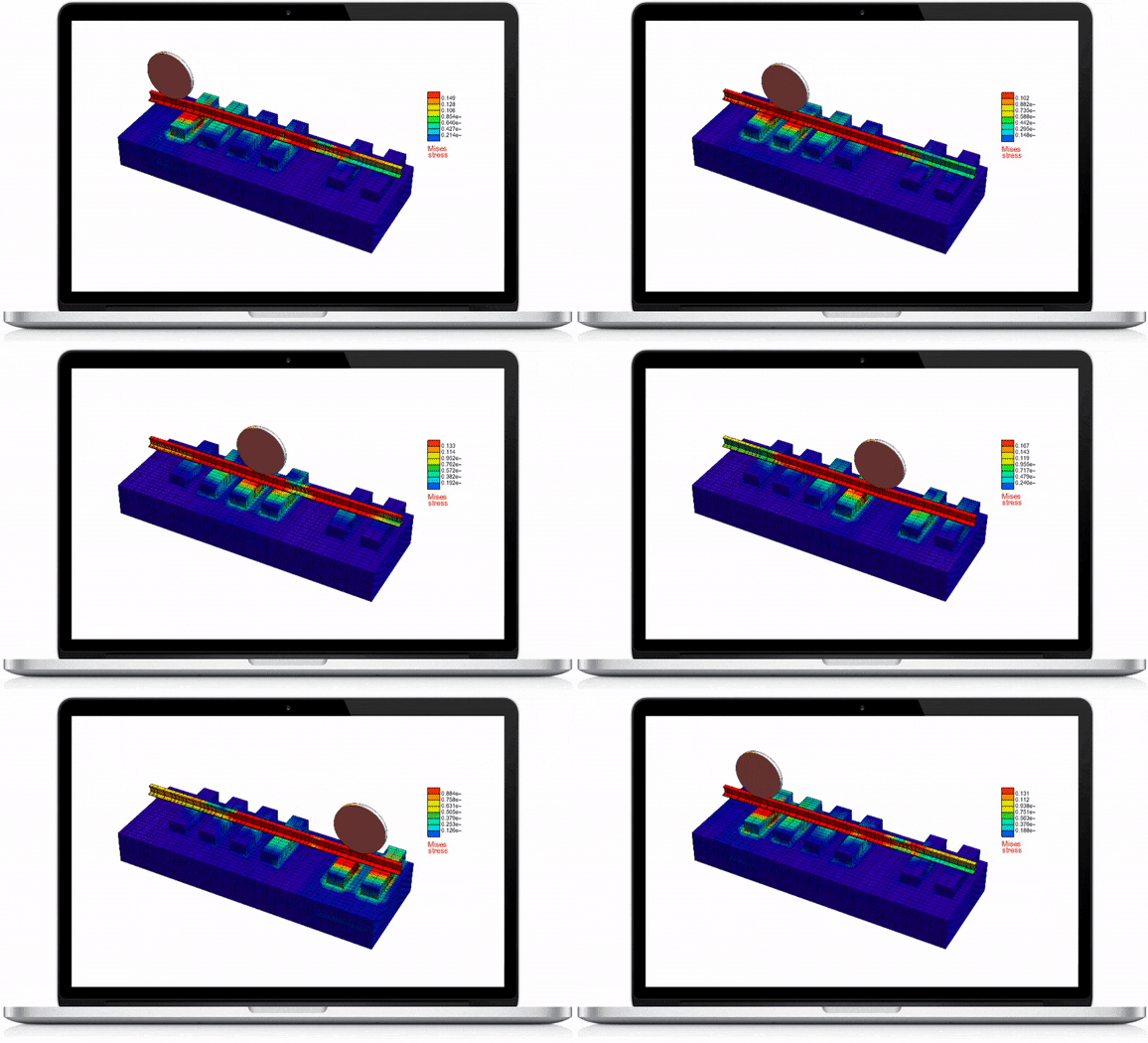
“Development of an innovative railway sleeper” is a research project carried out at The Slovenian National Building and Civil Engineering Institute and The University of Maribor.
Within this project SimTactics developed a finite element model of railway track by using the The Mathematica automatic code generation package AceGen and the finite element environment AceFEM.
The model consists of:
- the dynamic moving load,
- the rail,
- the rail pad,
- the sleeper,
- the ballast layer,
- and the sub-ballast layer.
The model is tailored towards parametric studies as it allows for quick modification of the geometry and the material parameters.
Demo Web App for a Telecommunication Company
- Demo version of cloud-based data management app
- Developed for telecommunication company
- PHP, Bootstrap, Ajax
- Pyhton, SQLite3
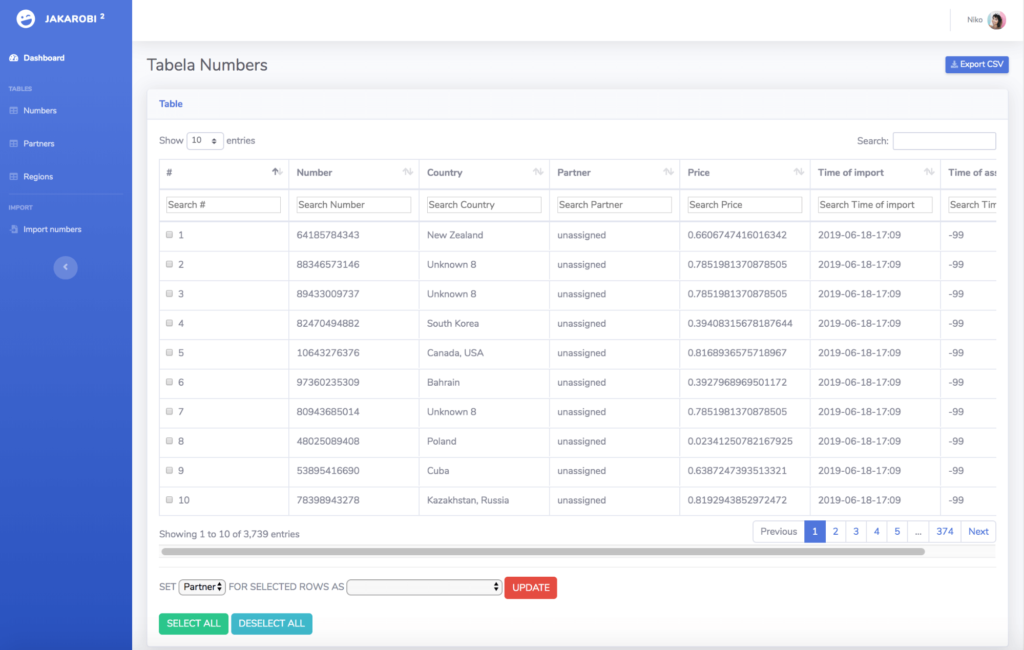
For a telecommunication company a demo web app was developed.
The backend of the app was built with:
- Python
- and SQLite3 database.
The backend was via API connected to the frontend created with:
- PHP (Bootstrap) and
- Ajax (javascript).
The demo version of the app considered three tables in the database:
- numbers,
- partners,
- and regions.
The logic of the app allowed for:
- importing numbers to the database,
- automatic sorting of the numbers to the regions (countries),
- manual assignment of numbers to partners,
- and exporting of the data to CSV files.
